
Stay in the Par Zone—Don’t Run Out!
If you’ve ever stood in the storage room wondering how much to order, you know how easy it is to fall back on guesswork—or the familiar phrase, “I think we’re low.” Unfortunately, that kind of estimating often leads to one of two costly problems: running out or overstocking.
Using par levels to guide ordering for daily-use items is a simple but powerful system that eliminates guesswork, saves time, and keeps your inventory in balance.

What Are Par Levels?
A par level is the target quantity of a daily-use item you want on hand at the start of each new order cycle. It’s the “just right” amount—enough to last through the entire cycle without running short. The order cycle is the number of serving days your order must cover—from the day you place it to the day your next delivery arrives, plus the days that delivery must last until the following one. For example, if your kitchen uses an average of 500 trays per day and your order cycle covers 8 serving days, your par level is: 500 × 8 = 4,000 trays. Each week, simply check how many trays you have on hand and subtract that number from your par level: Par Level – On Hand = Order Amount.
It’s fast, consistent, and math-based—no guessing required.

Why It Matters
You already forecast menu items using production records and participation data, but daily-use supplies often slip through the cracks. Many kitchens rely on habit or fear of running out—“Let’s order a few extra cases just to be safe.” But those “safe” extras add up quickly. They eat up storage space, tie up your budget, and make inventory harder to manage.
Using par levels helps you:
• Keep inventory properly stocked—enough for smooth service, not excess.
• Avoid over-ordering—freeing space and protecting your budget.
• Make training new managers easier—par worksheets provide a clear, consistent system anyone can follow.
• Simplify ordering—no more memory-based decisions or guesswork.
• Save time—weekly orders become quick, accurate, and repeatable.
Order Once Weekly
Even if your distributor delivers more than once a week, place one consistent weekly order for daily-use items. A fixed routine keeps everyone on the same page and prevents duplicate or missed orders. Ordering once weekly:
• Eliminates the risk of double ordering.
• Keeps inventory counts accurate.
• Creates a predictable, stress-free process.
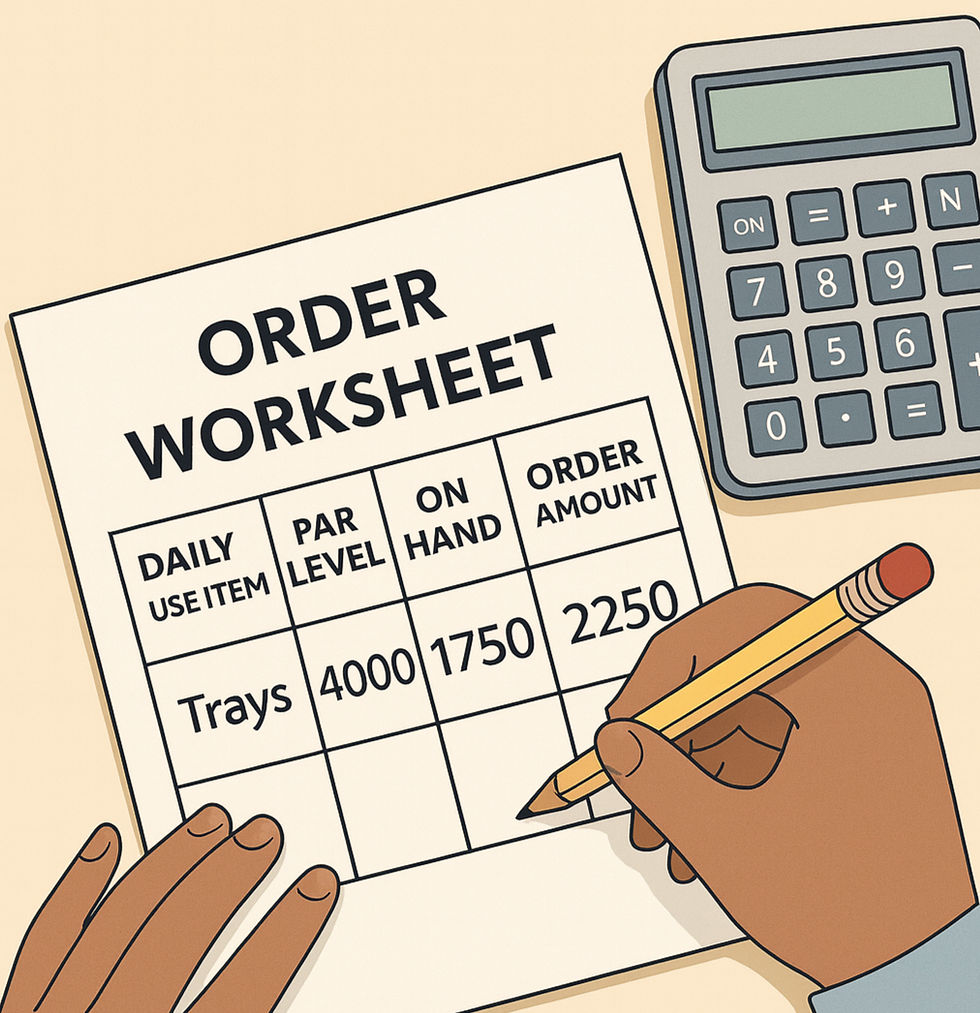
Build Your Par List Over Time
You don’t have to calculate every par level right away. Start with your highest-use items—like trays, gloves, and pan liners—and add more as you have time. Your list will grow into a complete ordering tool that saves hours each week. Par levels can also be established for snacks and beverages that are sold every day.
Tip: Many distributors offer printable order sheets with item numbers, pack sizes, and descriptions that you can use as a par worksheet—it speeds up ordering, ensures accuracy, and helps train new staff to follow the same process.
Final Thoughts
Forecasting manages your meals. Par levels manage your supplies. Together, they save time, prevent waste, and keep your kitchen running efficiently every week.


